Most AI qualifications teach AI as a subject. Students study what AI is, complete some exercises, get a certificate. Then they go into a job interview and can’t actually explain how they’d use it to do anything useful.
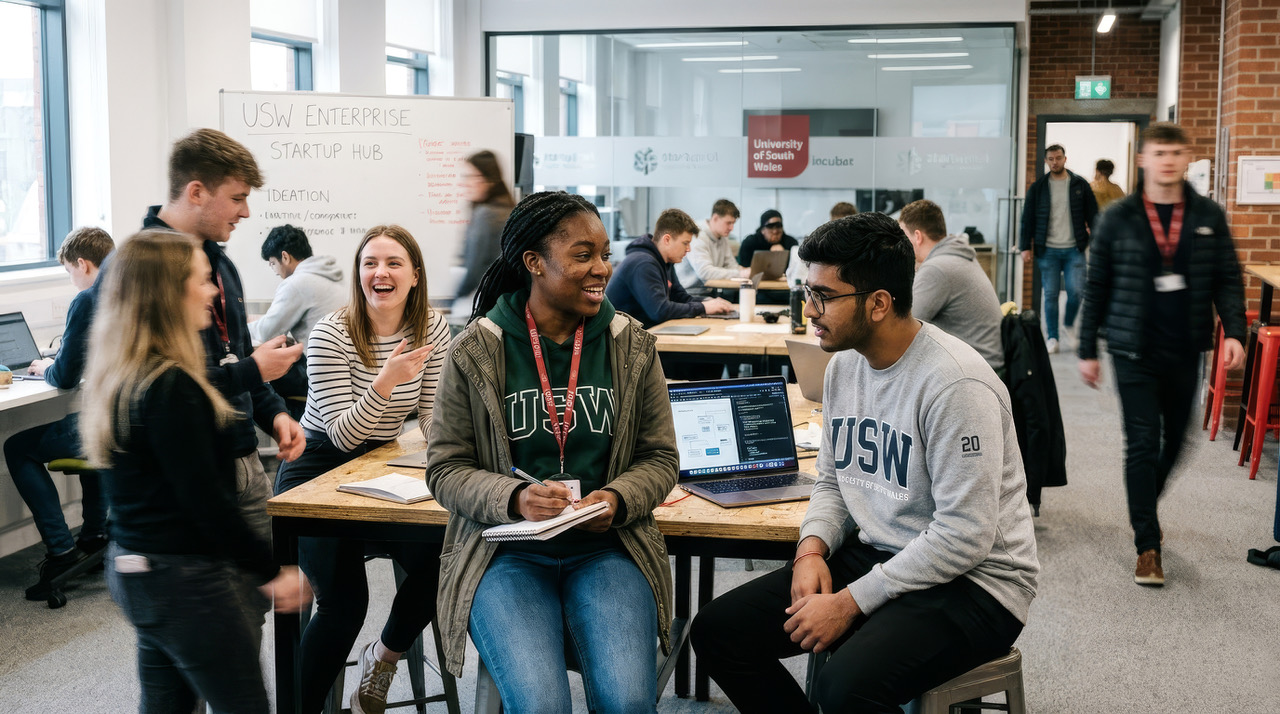
The IOEE is taking a different approach with the University of South Wales. Rather than bolting an AI course onto an existing degree, we’re developing professional AI accreditation that’s built directly into the curriculum of their BA (Hons) Business & Management programme. Students won’t study AI separately. They’ll use it every week to do the actual work of their course, and the accreditation will recognise that they can do it well.
What this looks like in practice
The degree’s entrepreneurship pathway, developed by Liam Newton at USW’s Faculty of Business and Creative Industries, already weaves AI into the teaching. In Year 1, students work through a module called The Founders’ Playbook: Build Your First Business, where every week includes a dedicated AI session. But these aren’t abstract AI exercises. Students use AI to generate financial projections for the startup they’re building. They use it to draft marketing strategies, create pitch materials, analyse competitors. The AI work serves the business work, not the other way around.
By the end of Year 1, students who meet the criteria will receive the IOEE Award in Applied AI for Business. Six units covering tool literacy, prompting, critical evaluation, practical application, ethics, and reflective practice. All assessed through the module work they’re already doing.
In Year 3, it goes further. The module Business 4.0: Disrupt or Be Disrupted has students co-creating digital products with AI, vibe-coding apps, building chatbots, writing AI policies for businesses, and completing a three-hour challenge where they have to produce a business plan and a functioning product using whatever technology they choose. Students who meet the criteria at this level will be eligible for the IOEE Diploma in Professional AI Practice, which covers advanced prompt engineering (including structured formats like JSON instructions), strategic application across complex business problems, critical analysis of AI limitations, innovation and monetisation, governance and compliance, and professional portfolio-level practice.
Why this matters for students
A student finishing Year 1 with the Award has something concrete to put in front of an employer when applying for internships or placements. Not “I did an AI module” but “I hold a professional accreditation from the IOEE that demonstrates I can use AI tools to produce business outputs, evaluate what they give me, and explain what I changed and why.” That’s a different conversation.
A graduate finishing Year 3 with the Diploma can show a portfolio of AI-assisted work across multiple business contexts, demonstrate they understand AI governance and ethics at a practical level, and articulate their AI practice in a professional setting. Both accreditations align with the UK’s AI Skills for Business Competency Framework developed by the Alan Turing Institute, which is already being adopted by DSIT’s AI Upskilling Fund and UKRI’s AI Skills Hub.
The philosophy behind it
The accreditation is built on a principle we’ve been developing across our work: AI is a tool, not a subject. The analogy we keep coming back to is the calculator. Nobody does a “calculator course” before studying maths. You learn to use one because it’s part of doing the work. AI should be the same.
That doesn’t mean every task should involve AI. The framework includes five levels of AI use that can be specified for different tasks, from “AI as Analyst” (where students only use AI to review their own work) through to “AI as Producer” (where AI generates a near-final output accompanied by critical reflection). The point is that students learn to make judgement calls about when and how much to use AI, not just whether to use it at all.
There’s also a 70/30 principle running through the design. On tasks where AI is heavily involved, the AI might produce 70% of the raw material, but the human expertise, editing, and contextual judgement shapes the final 30% that actually makes it good. Students who understand that distinction will outperform those who either refuse to use AI or hand everything over to it.
What’s next
The first cohort starts in September 2026. We’re currently finalising the Award criteria mapping against Liam’s Year 1 assessment briefs, and developing process log templates that will capture the evidence the Diploma needs when the Year 3 module begins delivery in 2028. We think this model has legs beyond USW. The approach of embedding professional AI accreditation into existing degree programmes, rather than creating standalone AI modules, could work across any business or professional degree where students are already using AI as part of their learning. If you’re involved in curriculum design at a university or college and this approach interests you, we’d like to hear from you.